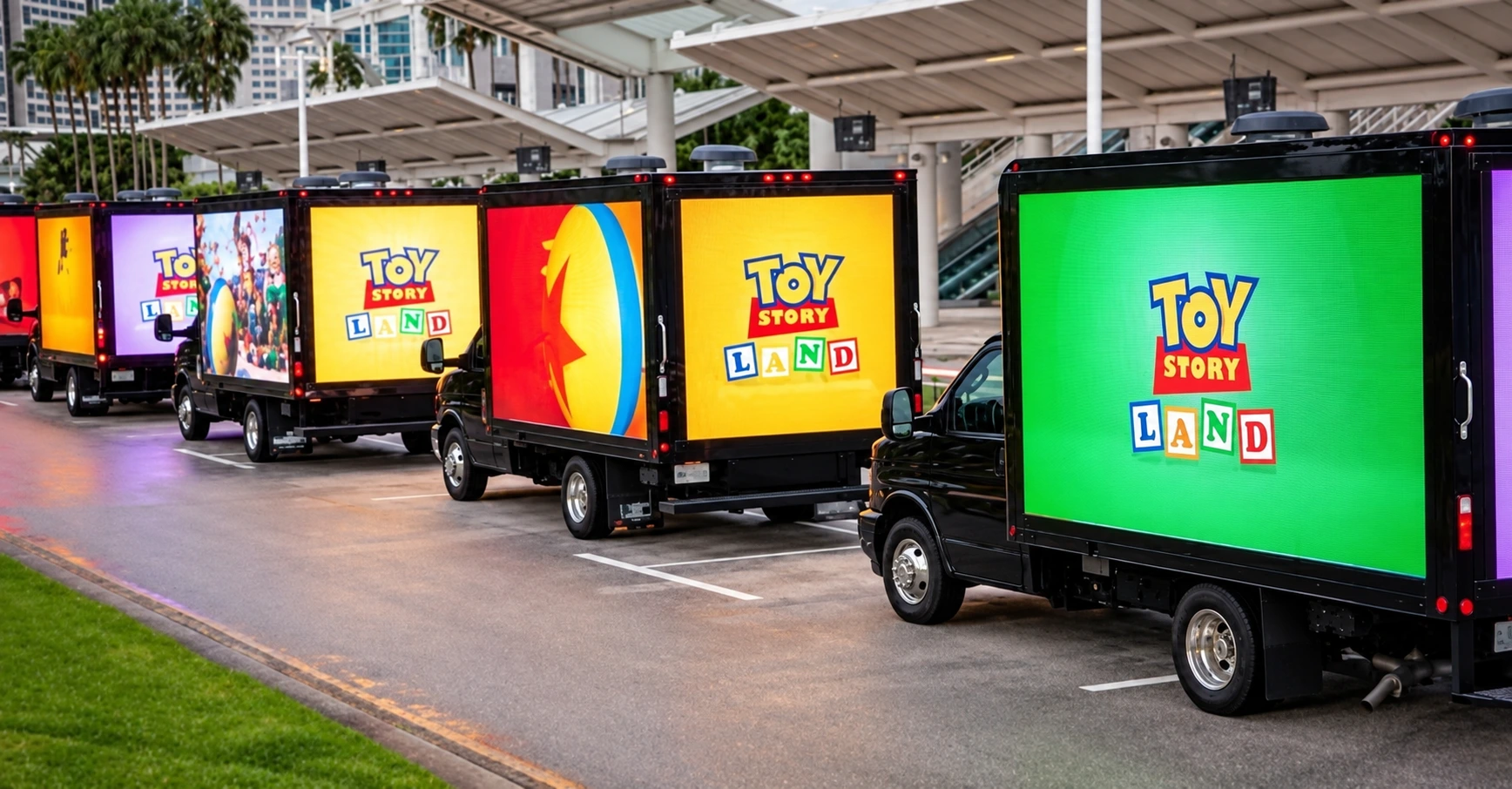
One digital mobile billboard truck can make a statement. A coordinated fleet can turn that statement into a moment. If your budget supports it, a multi-truck campaign deserves a serious look—especially when your goal is to launch something big, stand out around an event, or give people a brand experience they will remember.
The key is giving the trucks a plan. More vehicles create more creative possibilities, but the message, route and timing still have to work together.
1. The wow factor: make the campaign feel bigger
A line of LED advertising trucks carrying bold, connected creative creates a striking visual presence. The scale becomes part of the message. For a product launch, entertainment promotion or grand opening, that presence can help communicate that something worth noticing is happening.
The Toy Story Land campaign pictured above shows how colorful creative can connect a fleet visually. Each screen has its own design, while the campaign still reads as one recognizable brand story.
2. Give people more than one reason to remember you
Strong campaigns give audiences a simple idea they can recognize again. Multiple trucks let you repeat the brand while varying the supporting message: a character, a product, an offer or an experience. That creates opportunities for recognition without filling one screen with too much information.
Keep the logo, colors and main promise consistent. Change the supporting creative with purpose. Memorability comes from a clear idea repeated well; adding trucks alone does not guarantee it.
3. Give each screen a specific job
Your screens do not all have to say the same thing. Build the campaign around a few clear goals and assign creative accordingly.
- Introduce: Show the brand or new product with one bold visual.
- Explain: Highlight one useful benefit or reason to care.
- Build interest: Feature a character, product variation, experience or launch message.
- Prompt action: Show a short website, clear destination or simple next step.
For example, a concert campaign could use one truck for the artist, another for the date and venue, and another for ticket information. A retailer could feature the product, the offer and the store location across separate screens.
Every screen must still make sense on its own. A person may see only one truck, or see the vehicles in a different order. Include enough brand identity and context on each design to make that single exposure useful. Rear-screen QR codes can support a next step where pedestrians can safely pause; keep a readable short URL available too.
4. Choose concentrated impact or broader coverage
Keep trucks together when the goal is a coordinated visual moment on an approved route or at a permitted staging location. Split them across audience corridors when the goal is to reach different areas during the same campaign window. You can also plan a combination of both.
For an Orlando campaign, that might mean reviewing convention-area traffic, entertainment districts and hotel corridors against the audience you want to reach. The route should follow the campaign goal, with operating conditions, local rules and vehicle availability reviewed in advance.
5. Match the message to different audiences
A single launch may need to speak to more than one group. One creative set could introduce the brand to visitors, while another highlights a nearby location or time-sensitive offer for local customers. Multiple trucks make it possible to run these messages in different areas at the same time.
Keep the promise consistent across the campaign. Use the extra screen space to make the message more relevant, rather than introducing competing offers.
6. Create a visual moment worth capturing
A coordinated fleet can provide a compelling backdrop for campaign photography and video. Those assets can support your website, social channels, launch recap and sales materials after the trucks finish their routes.
Plan photography and video as part of the brief if you want those deliverables. Confirm safe locations, timing and permissions. A striking setup creates an opportunity for content; it does not guarantee social sharing or viral reach.
7. Give a major launch the presence it deserves
Multi-truck campaigns are worth considering for entertainment releases, attractions, retail openings, trade shows, concerts, brand launches and large public-awareness initiatives. They are especially useful when you have a strong visual concept and a defined campaign window.
The bigger footprint should serve a real objective. If the budget forces you to sacrifice readable creative, useful operating hours or a focused route, discuss a smaller fleet with a stronger plan.
Plan the campaign before choosing the truck count
- Set the goal: Awareness, visits, event attendance or another specific action.
- Define the audience: Who needs to see the message, and where do they travel?
- Map the screen roles: Decide what each creative communicates.
- Choose the deployment: Together, separate routes, or a scheduled combination.
- Confirm the full scope: Trucks, operating hours, creative, coordination, reporting and any photography.
- Plan measurement: Agree on route reporting and trackable links or offers where appropriate. Track inquiries separately from vehicle activity.
Ready to make a bigger impression?
Tell The Digital Mobile Billboard Company what you are promoting, where you want to run, your dates and your budget range. We can discuss a multi-truck campaign with creative that gives each screen a purpose.
Get a Multi-Truck Campaign Quote
Prefer to talk? Call 844-344-4586. Explore our campaign gallery or Orlando advertising coverage.